
 Setting aside the unverified (and, in many cases, unverifiable) results of yesterday’s elections for the moment, what caught my eye throughout the night were the turnout numbers, Democratic compared to Republican.
While the reported results of the races ran largely counter (surprise!) to the “GOP/TeaParty-fueled Massacre Slated for November!” meme that the corporate beltway media and related villagers have been endlessly re-enforcing with zombie-like precision over the last several weeks and months, the turnout of actual voters in the marquee state-wide primaries (races that we detailed, along with the e-voting systems in use, in our Super-ish Tuesday Backgrounder on Monday) seem to be of note when considering what November might actually look like when all is said and done.
I’d caution not to take too much from these numbers as there are various mitigating factors that could be used to explain them — or even explain them away — as noted below, but I think the numbers themselves are very much worth noting here, as I haven’t seen much coverage of this over the last 12 hours or so…
All numbers uncertified as of now, but taken directly from the appropriate SoS website.
KY Primary Voters in U.S. Senate Race:
DEM: 520,412
REP: 351, 927
Note: While the Republican Rand Paul v. Trey Grayson race received, hands down, the most publicity nationally, Paul would actually have come in third place had the race been an open contest between all candidates, as both of the two leading Democratic candidates Jack Conway and Daniel Mongiardo each received more votes than Paul.
But also note: KY has a similar recent history of a larger turnout in the Democrtic Senate primary, before the Republican wins in the general. For example:
2008 Primary voters
DEM: 619,904 REP: 195,297
The Republican incumbent Mitch McConnell ended up reportedly beating Democratic candidate Bruce Lunsford (on the 100% unverifiable voting machines that the majority of KY voters were forced to use that year): 953,816 to 847,005.2006 Primary voters
DEM: 218,969 REP: 114,940
The Republican incumbent Jim Bunning was said to have defeated the Dem Dan Mongiardo in the general that year (on the same unverifiable voting systems): 873,507 to 850,855.The last time there was a vacant seat being filled, as there is this year, was 1998. The state had not yet moved to unverifiable voting machines that year.
1998 Primary voters
DEM: 568,292 REP: 205,291
The Republican Jim Bunning was barely victorious over Democrat Scotty Baesler in the November general (before KY moved to unverifiable touch-screen systems): 569,817 to 563,051
PA Primary voters, U.S. Senate (99.7% reporting):
DEM: 1,045,653
REP: 818,727
Note: Unlike KY, PA’s most recent history has the party with the largest number of votes in the primary going on to win in the fall. Back in 2000 however, when the incumbent Republican Sen. Rick Santorum ran unopposed in the primary, he received fewer votes than the Democrats who would go on to lose in the fall.
But also note: Since Arlen Specter recently switched from the Republican to the Democratic Party this year, there may have been a lot of Republican-leaning voters who signed up to vote in the Democratic primary in order to vote for him this year, particularly as there wasn’t much of a contest on the Republican primary side with Specter having pulled out, sensing he’d be crushed by the Republican winner last night Pat Toomey.
AR Primary voters for U.S. Senate (92% reporting):
DEM: 301,408
REP: 135,888
Note: Arkansas voters may decide which party’s primary they’d like to vote in at the time they go to the polls and get their ballots. So there could have been a lot of cross-over voting in yesterday’s Democratic race in particular, with Republicans voting in the Democratic contest in order to affect things — one way or another — before November.
And also note:Additionally, there was also a minor candidate, DC Morrison, whose positions on virtually everything, were almost identical to a far Rightwing Republican! His entry in the race helped to ensure neither “moderate” Dem incumbent Sen. Blanch Lincoln, nor her slightly-less Right-leaning challenger Lt. Gov. Bill Halter received a 50% + 1 majority. So there will be a run-off both on the Democratic side, as well as the Republican side (where there were eight candidates last night!) held on June 8th. Those numbers may be more instructive for the November outlook. Perhaps.
OR Primary voters for U.S. Senate:
DEM: 361,850
REP: 254,970
Note: Incumbent Democratic Sen. Ron Wyden is very popular, in the usually-reliable Democratic state, so the numbers above aren’t of tremendous surprise, other than we’ve been told by the corporate media (and the GOP/Tea Party which they too-frequently represent) that this is a year about anti-incumbency and anger at Democrats. If the above numbers hold up in November, the Democratic incumbent Wyden should sail to easy victory.
Also note: The primary for open Gubernatorial seat also similar had more voter D voters than R, 363,368 to 302,431.
Fact is there were far more Democratic votes cast nationally in yesterday’s races than Republican votes.
Given the “conventional wisdom” over the last several months that the GOP was “energized” while the Dems were deflated, yesterday’s totals — even with their noted mitigating factors, and others not noted above — seem worth highlighting.
Again, not to make too too much of those numbers, but they do seem worth storing in your back pocket when/if you begin to hear the familiar — and almost always wrong — song of “conventional wisdom” coming from the blathering politico-mouthpieces and propagandists between here and November.























I guess the lesson learned is that Republicans don’t vote in primaries.
But those numbers from KY 2008 are hard to explain. Perhaps they reflect the authoritarian nature of Republicans. Maybe the common-folk Republicans let the establishment decide who should rule, neglecting the process until they’re told precisely which lever to pull every other year.
It must be nice.
The reason is that they don’t get busy voting the registered non-voters until November. The numbers speak for themselves.
Republicans are a non entity.
Perhaps the conventional wisdom of the fired up Republicans and deflated Democrats will have the salutary effect of getting Democrats worried enough to get out the vote
It ran counter to what the corporate owned media we’re supposed to think is “liberal” said, the one owned by 90% conservatives (Ed Schultz)
It makes me wonder how many of those democratic votes were republiklans crossing over to skewer the numbers and make them look like something they are not??? Ity has been done before, in fact, Limbaugh once advocated it.
Brad,
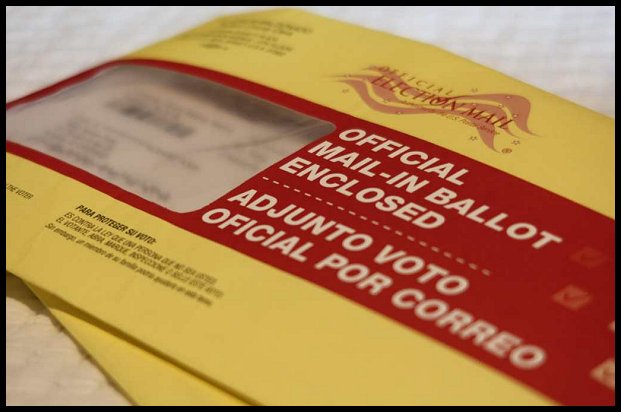
It’s about time that corrupt vote-counting systems throught the USA study and consider implementing Oregon’s mail-in ballot system. It is as foolproof a system as one can hope for.
Unlike the voting problems experienced in the other three state primaries, there were no problems with the Oregon mail-in ballot system.
http://www.democraticundergroun...esg_id=8103177
In the above post, note that Oregon paper ballots are available for hand recounts. Check out the Oregon voting publications:
http://www.sos.state.or.us/elec...w.pdf#page=120
http://www.sos.state.or.us/elec.../publications/
elec_law.pdf#page=144
And thids letter from:
John Lindback, Director
Elections Division
Oregon Secretary of State’s Office
http://www.oregonvrc.org/2008/0...ified_colorado
By Administrative Rule all vote tally machines used in Oregon are required to meet federal voluntary system standards. All of the ES&S equipment you reference have met these standards and are listed as certified on the National Association of State Elections Director’s web site: http://www.nased.org/certification.htm In addition, all vote tally systems used in Oregon must undergo testing as defined in Oregon Statute (ORS 246.550 and ORS 246.560). With the release of Untiy 3.0.1 ES&S complied with these requirements in June of 2006. We are quite satisfied with the level of testing our consultants do as part of our Oregon certification process. Our staff, including myself, monitor the work of the consultants and we are continually impressed with the
vigorous testing and challenging of the efficacy of the machines. Based on our conversations with the Colorado review team, in addition to the ES&S 650s performance in Oregon so far, we do not see a need at this point to require ES&S to go through a recertification in Oregon. But we will continue to monitor the situation.
Being an all vote-by-mail state, Oregon has many differences from Colorado in our vote tally process. Colorado uses vote centers and precincts in a distributed vote and tally process. Oregon utilizes a centralized vote tally process with all votes received and tallied at County Elections Offices. This centralized practice allows for much greater control of the tally process. For example, each ballot envelope received by the County Elections Officials is scanned, signature verified and then accepted for counting. This process is done using Oregon’s Centralized Voter Registration System. This system is completely separate from the vote tally systems used in Oregon Counties. It provides a cross reference in that the number of ballots received and accepted for counting equals the number of ballots counted by the tally systems. In addition local election officials are required by statute (ORS 254.235) to perform logic and accuracy testing prior to each election and after the counting is done. In addition, as you know, the
Legislature adopted a new law that takes affect this year that requires for each general election a post-election handcount of select precincts. These will be conducted in addition, of course, to the normal routine recounts we do in Oregon because each election inevitably includes a few close races.
I must reiterate here an important fact. No recount conducted in Oregon has ever turned up evidence that a tally machine failed to correctly count votes. A full recount is the ultimate test and with each election we always have at least one or two.
Uhggg. The Oregon mail in ballots? Yechh!!! No way!