Today on The BradCast: When I first saw the headline for the new report, I’d assumed it referred to a corporate political spending record for a midterm election cycle. Nope. Silly me. It meant all-time record for any cycle, including the 2024 Presidential election. [Full audio for today’s show follows this summary.]
FIRST UP, however, before being joined by the author of that new report, a few other things…
New data released by the U.S. Government Accountability Office (GAO) on Wednesday reveal that the number of employees who work for Amazon or for gig employers like Uber, Lyft, Doordash and GrubHub who are forced to depend on SNAP (food stamps) and Medicaid has skyrocketed in recent years. Jeff Bezos‘ Amazon tops the chart. In other words, taxpayers are on the hook to help make sure that those employed by the world’s second wealthiest man can afford to eat and receive healthcare. The out-and-out bribes paid by Bezos to Donald Trump are paying off nicely — as are the funds that huge corporations are now pouring into federal elections, as discussed with our guest today. See below.
Also today, primary election results out of Arizona yesterday, where 2020 election deniers endorsed by Trump secured the GOP nominations for Governor and Sec. of State. If victorious this November, Rep. Andy Biggs, who voted against certifying the 2020 election in Congress, and State Rep. Alexander Kolodin, who was sanctioned by the state bar for his involvement in two fraudulent cases brought against that same election, will oversee the 2028 Presidential election results in the critical battleground state as Governor and Sec. of State respectively.
All three of the state’s top statewide elected officials, Gov. Katie Hobbs, Sec. of State Adrian Fontes and Attorney General Kris Mayes ran unopposed on Tuesday for reelection on the Democratic side.
More details on several other noteworthy results out of AZ on Tuesday on today’s program.
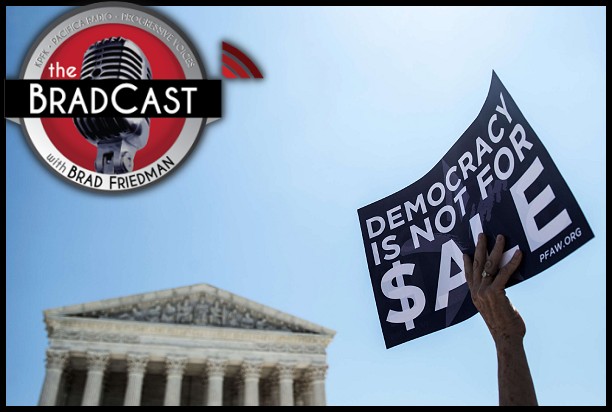
NEXT UP… In late June, the corrupted, activist, Republican U.S. Supreme Court majority struck down yet another campaign finance limit based on laws adopted by Congress and signed by the President. This time, in National Republican Senatorial Committee v. FEC, the Court gave the greenlight for political parties to share unlimited funding and coordinate with political candidates. Previously, only outside SuperPACs were able to sink unlimited money into directly attacking or supporting candidates, even if they couldn’t coordinate with their campaigns.
Now, thanks to SCOTUS, the pipeline is wide open for SuperPACS to give unlimited money to political parties which may, in turn, share that funding without limit and coordinate its spending with campaigns.
The opinion in NRSC v. FEC, handed down on June 30th, was just the latest in a years-long series of federal campaign finance limits adopted by Congress and struck down by the Roberts Court since 2010’s appalling Citizen United ruling.
On the very same day, before that ruling could possibly kick in, good government non-profit Public Citizen released a new report finding that “Corporate Supremacist SuperPACs” have already spent some $517 million on the 2026 midterm elections. That number doesn’t include Dark Money spending, and there are several months left to go before the November general. But the amount of corporate spending has already shattered the previous record from the 2024 Presidential election.
Incredibly, that $517 million, spent this year alone to date, is nearly one-third of the combined $1.58 billion spent by corporations to influence federal elections since Citizens United opened the floodgates 16 years ago.
Public Citizen finds that nearly three-fifths of the corporate political spending this year, $294 million, comes from the cryptocurrency, AI, Big Tech and online betting industries alone.
We’re joined today to discuss all of this by RICK CLAYPOOL, Research Director at Public Citizen and author of their new report. First, he explains his use of the term “Corporate Supremist SuperPACs.” By way of contrast with corporate election spending prior to 2024, when the spending might have been focused, for example, in support of a particular type of ideological Republican, the spending is now pooled by corporate sectors to advance the interests of the industries themselves.
“These SuperPACs are set up to maximize their influence in Democratic and Republican primaries,” Claypool tells me. “They’re set up not to support or attack any particular candidate or party — though they’re doing that — but their primary goal is championing the interests of the corporations themselves. Putting half a billion dollars to what is essentially the single issue of increasing corporate profits.”
It comes about after “the crypto sector engaged so heavily in the 2024 elections. This shattered the general norm against corporate engagement in elections in this way. Their spending was effective. Their goal was to discipline candidates, to stop those who might want to regulate the sector, and elevate those who would carry water for the industry,” he explains. It worked for crypto, bigly, last time around. So, this time, AI, Big Tech and online gambling are getting in on the fun. Bigly.
Other than AI — including its insatiable drive for the construction of resource intensive data centers — most of the industries are “farfrom a top priority for most Americans,” Claypool argues. And yet, crypto’s 2024 gambit is paying off “with how much time and energy has been spent [by Congress] debating regulatory policy to get to something that will support the crypto currency sector.”
“There has long been a partisan bent in terms of corporate spending,” Claypool, who has been covering campaign finance issues for years, observes. “It generally tends to favor Republican candidates. What is new is the corporate supremacist superPACs don’t care about parties. They want to pick candidates who will do what the industry wants regardless of party.”
So, what can actually be done about any of this? Particularly, given that the corrupted Roberts Court has been on a tear for at least the past 16 years to do away with any and all statutory limits on political spending? Claypool has a few ideas. (As do I!) Please tune in for yet another maddening episode of The BradCast…