
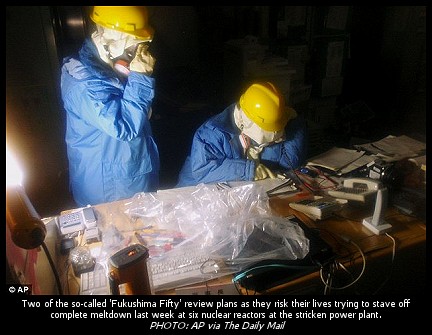
The first photos of the so-called “Fukushima Fift,y, the “anonymous band of lower and mid-level managers” (as described by the Daily Mail today in their photo essay) who stayed at the crippled Fukushima Daiichi plant last week, as the rest of the workers were evacuated when radiation had reached record levels there, have now been published by AP.
“Despite sweltering heat from the damaged reactors, they must work in protective bodysuits to protect their skin from the poisonous radioactive particles that fill the air around them,” the Daily Mail writes, in its heartbreaking piece, “But as more radiation seeps into the atmosphere minute by minute, they know this job will be their last.”
Workers were again evacuated from the Fukushima reactors 3 and 4 late on Thursday (late Wednesday US time), after black smoke once again began to emanate from Unit 3, where a dangerous mix of both uranium and plutonium fuel the reactor, as well as sit in largely unprotected spent fuel ponds in the same damaged building. The roof and walls were blown off of Unit 3 last week after venting of radioactive steam in the reactor led to a hydrogen explosion.
News reports today say that the black smoke, the cause of which is still unknown, has dissipated a bit at Unit 3, and this quick summary of the reactors’ status at Fukushima (March 23, 20:00 UTC) from the International Atomic Energy Agency (IAEA) — which has not always been as up to date as some of the actual news sources on the ground — suggests workers have now returned to the plant.
“Crews continued today to use a concrete pump truck to deliver high volumes of water into the Unit 4 spent fuel pool, where there are concerns of inadequate water coverage over the fuel assemblies,” according to the IAEA.
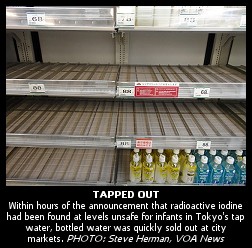 The biggest news last night was the announcement by the Tokyo Metropolitan Government that radioactive iodine levels in the city’s municipal tap water has now increased to levels that are no longer safe for infants. That, according to VOA News’ Steve Herman latest report (as well as other sources in Tokyo), has led to a “panic” and a run on bottled water at stores, many of which have now run out entirely.
As Herman reports:
…
The announcement immediately prompted panic. Citizens began buying huge amounts of bottled water in Tokyo, with some purchasing it by the boxes.
Japan’s government quickly asked the public to refrain from excessive purchases of water and said it is looking at ways to provide pure water to families with infants in the Tokyo Metropolitan area.
Beyond that, despite those setbacks at this hour, the status at the Fukushima Daiichi plant seems to be largely in the same place as it was during our previous update yesterday, as lights are slowly coming back on at the various units now that power has been restored to all of them from the grid. But pumping and cooling equipment continues to be malfunctioning in all but the 5 and 6 units at the plant, so work continues to pump water in hopes of keeping down temperatures and radiation at Units 1 to 4.
NOTE: We will be interviewing, Voice of America’s Northeast Asia Bureau Chief Steve Herman — who has been in both the Fukushima prefecture and Tokyo over the past 13 days since Japan’s 9.0 earthquake and ensuing tsunami — on the latest news out of Fukushima and Tokyo, later today during our show on Los Angeles’ Pacifica Radio affiliate, KPFK 90.7FM at 3:30pm PT (6:30pm ET). You can listen live online at KPFK.org, and we’ll try to post the full show later on this evening at The BRAD BLOG.
UPDATE 6:39pm PT: My KPFK interview with Herman, live from Tokyo, including the latest news on: ‘Neutron beams’, water ‘panic’, black smoke and the responses from TEPCO, the government and the people of Japan, is now posted here…



















I guess it will be interesting to learn whether and to what extent VOA has an agenda relative to disclosures surrounding this event – as an international propaganda organ of the US Government. If Tokyo’s water supply is already too contaminated for infants to drink (and likely adults too), how many days should one surmise it will take until that water supply is too contaminated for ALL to drink…and for how many centuries thereafter? Is there any logical reason to assume this is not a trend?
If the entire water supply of Tokyo becomes too toxic for human use, then what conclusions can we draw about the future evacuation of the entire island of Japan? How soon? To where? By what means?
plunger. it is an excellent point. one gap. how possible and how likely is it that any government will even try let alone disclose that they should try to move that many people that fast? and to where? to eat and drink what?
Japan’s earthquake is a big lesson for all over the world so we should forget to build Nuclear plants.
Would anyone else like to see the “Fukushima 50” of low level managers replaced with a “Fukushima Dream Team” made up of the CEO of all the nuclear power companies and the heads of all nuclear regulator agencies? It might give them incentive to take safety issues more seriously.
I am not optimistic on the long term survival of anyone that expects to live within 20 miles of that facility, ever.
While I am no expert on radiological contamination, I am no novice on the risks either.
If you are finding radioactive iodine in the drinking water, why wouldn’t you also be finding significant quantities of transuranics and other fission products as well?
A lot of these elements are pyrophoric and the gulf war taught us much about how these elements migrate when they burn. Radioactive iodine is only a very small tip of this iceberg.
Jay lindberg