
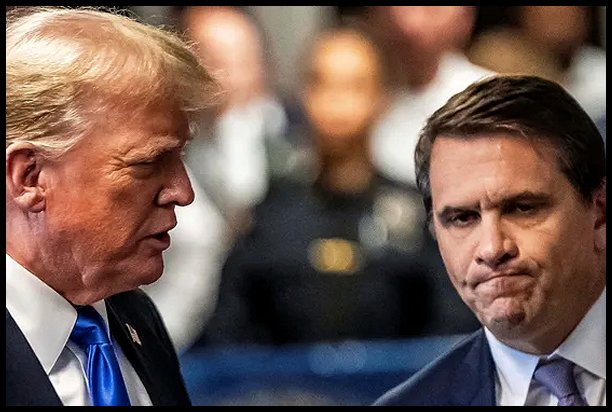
Did President Trump and others engage in a conspiracy to defraud the United States in the lawsuit he filed against his own government? Did they, in fact, “perpetrate a fraud on the judicial machinery itself”? That is the ultimate legal question. In fact, it’s the question that has suddenly arisen in a federal courtroom in Florida.
Last week, 35 former federal judges filed a Motion with U.S. District Court Judge Kathleen M. Williams (SD FL), who had been overseeing Trump v. Internal Revenue Service until it was suddenly withdrawn by plaintiffs last month.
On Friday, after receiving the motion from the jurists, Judge Williams issued an order to reopen Donald Trump’s $10 billion lawsuit against the IRS. The suit had originally been filed by attorneys Alejandro Brito and Daniel Z. Epstein on behalf of President Donald J. Trump, his sons Don Jr. and Eric, and the Trump Organization against the IRS that was — and is — run by Trump himself.
The immediate impact of Judge Williams’ decision to reopen the case was to shut off access, for now, to a Judgment Fund created by Congress to pay for court-supervised settlements with victims of alleged mistreatment at the hands of the federal government. Those involved in this suit had hoped to use the fund to dole out $1.776 billion to supposed victims of government “weaponization” during the Biden Presidency. The so-called “Anti-Weaponization Fund” would offer cash payments to previously convicted and then pardoned J6 insurrectionists, as well as anyone else deemed worthy by a panel of five Commissioners who serve at the pleasure of the President. Payees might, in fact, include Trump, his family and his companies.
The renowned conservative retired jurist J. Michael Luttig and 34 other former federal judges wrote in their motion:
The monetary aspects of the illegal scheme had already been blocked when U.S. District Court Judge Leoni Brinkema (ED VA) issued a Temporary Restraining Order last week in Floyd v Department of Justice. That separate case was filed by Law Professor Andrew Floyd, a former DOJ attorney, who successfully prosecuted violent January 6th insurrectionists. Floyd initially saw his own hard work undone when, on his first day in office, Trump issued a blanket pardon of more than 1,500 convicted rioters. That indignity was enhanced when the able prosecutor was fired by the Trump DOJ.
Unlike the TRO issued in Floyd, Judge Williams seeks to accomplish a great deal more than simply blocking access to the Fund. As explained in her order, she has reopened the lawsuit itself to “investigate ‘grievous allegations’ presented by the” former federal jurists.
As described by Judge Williams, the “non-party movants” (the retired federal judges) allege in their motion that “Plaintiffs’ voluntarily dismissed this litigation solely to avoid judicial scrutiny of a lawsuit that was ‘collusive from the start’ and was only filed to provide an imprimatur of legality for an unlawful settlement.”
Despite mainstream media mischaracterization of the “Anti-Weaponization” fund created by Trump and his Acting Attorney General Todd Blanche as part of a “settlement” in the case against the IRS, Judge Williams noted in her previous Order Closing Case that, in fact, there was “no settlement of record” because the parties had neither filed nor referenced a settlement.
Indeed, the Court did not receive either the “Settlement Agreement” purporting to establish the “Anti-Weaponization Fund” or an Addendum to the “Settlement Agreement”, signed only by Blanche, until copies of those documents were filed by the 35 former judges as exhibits attached to their motion. The remarkable Addendum purports to prevent the IRS from ever auditing or investigating Trump, his family and his companies with respect to their tax filings.
In her order to reopen, Judge Williams quotes the former judges’ argument that the Addendum “purports to ‘forever bar and preclude’ the United States from pursuing claims that could have been [otherwise] asserted [against] Plaintiffs.” The motion, she writes, highlighted that “Defendants [IRS, represented by the DOJ]” did not “‘even try to defend against Plaintiffs claims’ despite their opposition to nearly identical claims in other litigation.”
In fact, as New York Times reported last month, IRS attorneys had compiled a comprehensive defense against Trump’s suit in a memo that DOJ chose not to pursue in favor of the so-called “settlement”.
Citing authority for the court to “investigate serious misconduct as a collateral issue”, Judge Williams ordered Plaintiffs to file a response to the 35 former judges’ motion, “including (1) the charges of collusion and whether the Parties are truly adverse; (2) the assertion whether dismissal in this case was premised on deception by the Parties; and (3) the question whether the case should be reopened because the Court was the ‘victim of a fraud’.”
The former judges allege that the “parties’ collusive activity perpetrated a fraud on the judicial machinery itself.” Judge Williams cited Rule 11 of the Federal Rules of Civil Procedure in support of her decision to reopen to “investigate” that “collateral issue”.
While the Court goes on to discuss the question of imposing “sanctions” upon Plaintiffs’ counsel, everyone involved in this fiasco, including the President, his sons and several attorneys at the DOJ, could soon face serious legal jeopardy.
Conspiracy to Defraud the U.S.
The provisions of 18 U.S.C. § 371 prohibit conspiracies to defraud the United States. Supreme Court precedent, according to DOJ Archives, establishes that it isn’t necessary to show that the government actually suffered a pecuniary loss in order to secure a conviction. The crime occurs when two or more persons conspire to either “cheat the Government out of money or property…or obstruct one of its lawful government functions by deceit, craft or trickery…”
If the allegations set forth by the former judges’ motion are confirmed, this case entails both a conspiracy to “cheat the Government out of money” (the slush fund) and to “obstruct” a lawful “government function” (enforcement of tax laws).
A conviction can lead to five years of imprisonment.
There are a number of individuals who could possibly be charged in this instance. In addition to Plaintiffs’ attorneys, those who signed the initial “Settlement Agreement” on behalf of the government (IRS CEO Frank Bisignano and Assistant AG Stanley Woodward), together with Blanche, who signed the Addendum, could ultimately find themselves at the wrong end of an indictment. So, too, the President, Don Jr. and Eric Trump.
There is, of course, a potential defense available to the President’s sons: Did they know or condone what took place? If raised, prosecutors could potentially explore communications and records between the clients and their attorneys under the “crime fraud exception” to attorney/client privilege. An attorney and a client cannot meet and confer in order to carry out a crime.
In this instance, the President would be hard pressed to claim that taking part in a conspiracy to defraud the United States amounts to an “official act” that warrants the immunity absurdly bestowed upon him by a Supreme Court majority in Trump v. U.S. (2024).
Impeachment and Disbarment Proceedings
Given the politicization — and, indeed, weaponization? — of the current DOJ under Trump, it’s doubtful any indictments would be handed down unless the President, along with Blanche and Woodward, were all first impeached and removed from office. A conspiracy to defraud the U.S. would certainly qualify as an impeachment-worthy “high crime”. But, as demonstrated by the Second Impeachment of Donald Trump, even hard evidence that he engaged in an insurrection against the federal government proved insufficient to secure the needed 2/3 vote to convict in the U.S. Senate.
Even if a “blue wave” election this November leads to Democrats taking majority control of both chambers of Congress, removal via impeachment remains a long-shot at best, albeit one that would be appropriate.
Finally, as illustrated by the saga of John Eastman, all of the attorneys involved in this fiasco will likely face disciplinary State Bar proceedings that could lead to disbarment, whether they face impeachment, indictment or not.
UPDATE, Midday 6/1/26: The Trump administration announced that the President plans to drop the “Weaponization” fund. It was a classic too little, too late move. Even if President Trump stipulates to the entry of a permanent injunction in the Floyd case, it would not put an end to Judge Williams’ “investigation” into whether the President perpetrated a fraud upon the court in Trump v. IRS.
As noted above, prosecutors need not prove there was actual pecuniary loss. If the allegations presented by the 35 former judges are established as fact, then a crime occurred the moment the President and his minions entered a conspiracy to defraud the United States.
 Ernest A. Canning is a retired attorney, author, and Vietnam Veteran (4th Infantry, Central Highlands 1968). He previously served as a Senior Advisor to Veterans For Bernie. Canning has been a member of the California state bar since 1977. In addition to a juris doctor, he has received both undergraduate and graduate degrees in political science. Follow him on Twitter and Bluesky


















Let’s hope justice will be done but knowing the Supreme Court they will protect them.
Maybe. But I say let’s make ’em work for it! 🙂
The was more con than spire.