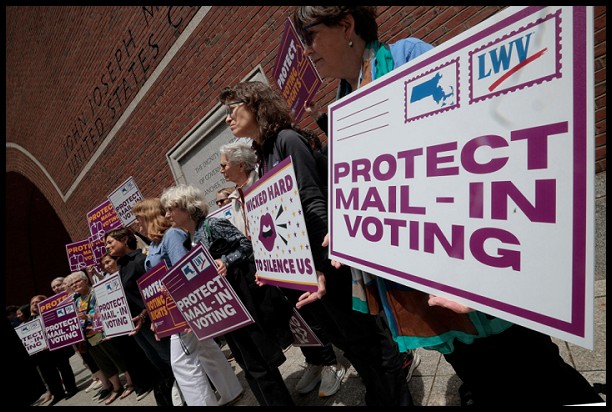
A federal judge in Massachusetts this week, blocked Donald Trump’s unconstitutional attack on the right of U.S. citizens to vote by mail during the upcoming Nov. 3 election.
The ruling was issued by U.S. District Court Judge Indira Talwani in California v. Trump, a case filed by 22 States and the District of Columbia. The Plaintiff States contested the legality of Trump’s March 31, 2026 Executive Order (“EO”) which, the court noted, “purported to allow the U.S. Post Office [“USPS”] to refuse to forward mail-in ballots submitted by States to any citizen whose name does not appear on a Department of Homeland Security Confirmed Citizen List.”
The ruling on Thursday followed another, just one day earlier in another federal court, that similarly blocked a separate elections-related Executive Order issued last year by Trump. That one would have would have required people to show documents proving their citizenship when registering to vote.
Under the EO blocked by Judge Talwani, State and local election officials “potentially face criminal prosecution if they issue ballots to anyone” whose name does not appear on the admittedly deficient list. This, the court noted, would be especially onerous for California, which, per State law, “mails every registered voter a ballot.”
The Plaintiff States filed a Motion seeking summary judgment, declaratory relief and the issuance of a permanent injunction that would prevent the relevant federal agencies from enforcing the key provisions of the EO with respect to federal elections to be conducted between now and the Nov. 3, 2026 midterms. The States argued, and the court agreed, the EO was beyond the scope of the office of President. It violated the Constitution’s Elections Clause, separation of powers and other provisions. Judge Talwani deemed the Order “legally void.”
In striking down the EO, the court relied not only upon constitutional and statutory law supporting the Plaintiff States’ motion, but also upon the absence of a genuine dispute of material facts. Indeed, admitted facts reveal the EO amounts to little more than a hasty and ill-considered attempt to achieve mass disenfranchisement that could, as the court observed, quoting an amicus (friend of the court) brief, “wreak havoc on the electoral process nationwide.”
Unconstitutional
There can be no doubt the President, who, to date has failed to persuade Congress to pass his so-called SAVE America Act — which would disenfranchise millions of voters with a mandate for documentary proof-of-citizenship for voters, among other things — has strayed beyond his executive authority and attempted to usurp the legislative power of Congress by issuing an EO that aspires to accomplish mass deprivation of the right of lawfully registered voters to receive and then cast a mail-in ballot.
As noted in Judge Talwani’s decision, except to the extent that it has been preempted by an Act of Congress, the words of Article I of the Constitution empowering “States to prescribe the ‘Times, Places and Manner of holding [congressional] elections” have been broadly interpreted by the U.S. Supreme Court “to ’embrace authority to provide a complete code for congressional elections, not only as to times and places, but in relation to notices, registration, supervision of voting, protection of voters, prevention of fraud and other corrupt practices, counting of votes and other practices.'”
A poignant example of Congressional preemption can be found in Arizona v. Inter Tribal Council of Arizona, Inc. (2013) — a case cited by Judge Talwani. In that matter, the U.S. Supreme Court ruled that a state law that mandated documentary proof of citizenship in order to establish eligibility to vote was preempted by the uniform federal registration form adopted by Congress pursuant to the National Voter Registration Act of 1993 (“NVRA”). The NVRA and it’s national registration form require only a declaration under penalty of perjury that the applicant is a U.S. citizen.
“The Constitution,” Judge Talwani observed, “does not grant the the President any specific powers over elections.” Additionally, she found, “[n]o law enacted by Congress delegates authority to control mail-in voting to USPS.”
The Constitution mandates that a President “take Care that the laws be faithfully executed” — an obligation which, as SCOTUS previously observed, “refutes the idea that he is to be a lawmaker.”
Glaring List Deficiencies and Mass Disenfranchisement
Trump’s EO directs a component of the Dept. of Homeland Security, in coordination with the Commissioner of the Social Security Administration, to compile lists of citizens eligible to vote. It requires DHS to establish the infrastructure to transmit “Confirmed Citizen Lists” by June 29. It also directs USPS to initiate rules and provide each State with a list of eligible individuals “enrolled with the USPS” by July 29. Those dates are at odds with the laws of Plaintiff States, all of whom allow the issuance of new registrations up to 30 days before an election. (Some of the States allow same-day registrations on Election Day. Deadlines for registration months prior to Election Day would prevent hundreds of thousands, potentially millions of otherwise lawful voters, from being able to vote at all this year.)
The Trump regime’s response to the Plaintiff States’ claim that “the President lacks authority to establish Confirmed Citizen Lists” was nothing short of astounding. “It is not even clear whether and when these lists will be created,” the government countered, “much less in what form, based upon what data, or how they might be used.” Indeed, in her decision, Judge Talwandi noted that, during the June 2 hearing on the Plaintiff States’ motion, “the government admitted that compliance with federal privacy law would necessarily render any Confirmed Citizen List under-inclusive.”
“It is clear,” she observed in response, “that the federal agencies charged with compiling Confirmed Citizen Lists lack the ability to create complete and accurate lists of U.S. citizens residing in every State.” The court cited a number of deficiencies in the databases that “do not necessarily track name changes (such as when a woman changes her name at marriage) or residence changes…”
Those infirmities can also be found in the House passed SAVE Act. The Center for American Progress estimated that the Congressional SAVE Act, if adopted by both chambers and signed by the President, could disenfranchise as many as 69 million women who took on their spouse’s name when they married. Fortunately, to date, Trump has failed to secure Senate approval of an Act that could serve as the death knell for this nation’s nearly 250-year-old experiment in representative democracy.
Court blocks criminal investigations
Judge Talwani expressly struck down the provisions of sections 2 and 5 of the EO which purported to make it a federal crime for State or local election officials to furnish mail-in ballots to any individual whose name does not appear on the yet to be developed Confirmed Citizen List. The court expressly enjoined the “Department of Justice and Acting Attorney General Todd Blanche, including their officers, agents, servants and employees” from “initiating any investigation or prosecution” of State or local officials for failing to comply with Trump’s illegal and unconstitutional EO.
 Ernest A. Canning is a retired attorney, author, and Vietnam Veteran (4th Infantry, Central Highlands 1968). He previously served as a Senior Advisor to Veterans For Bernie. Canning has been a member of the California state bar since 1977. In addition to a juris doctor, he has received both undergraduate and graduate degrees in political science. Follow him on Twitter and Bluesky.