
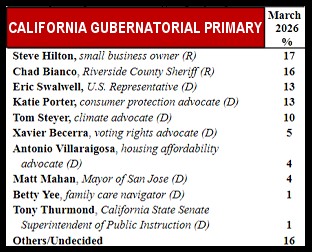
 The information from two recent polls on California’s upcoming Gubernatorial race suggests a moment we’ve long warned about. One where California’s “Cajun Primary” system poses a potential disaster not only for the state’s Democratic Party but also for small “d” democracy.
At its core, democracy requires “majority rule” even as the minority right of dissent is respected. As explained by the Albert Shanker Institute, “majority rule” does more than provide a mechanism for democratic decision making. “The principle also establishes the equality of all citizens. Each person counts equally; there is no weighted vote for anyone.”
With that in mind, a Public Policy Institute of California (PPIC) survey in February, and a more recent UC Berkeley poll in March, might be setting off alarms for state Democrats. It should be a warning for small “d” democracy as well…
No Democrat on this November’s Ballot?
According to PPIC, as of February, the top five gubernatorial candidates in the June 2 primary were Republican Steve Hilton (14%), Democrat Katie Porter (13%), Republican Chad Bianco (12%), Democrat Eric Swalwell (11%) and Democrat Tom Steyer (10%). There are some thirty additional candidates who did not reach the double digit threshold.
UC Berkeley’s poll, released in March, lists the same top five candidates, but places them in an even more troubling order: Republicans Hilton and Bianco top the list, with 17% and 16% respectively, followed by the Democrats Porter and Swalwell, tied for third at 13%, and Steyer at 10%.
Hilton is a former Fox “News” host. Bianco is the Riverside County Sheriff who has been sharply criticized by California Attorney General Rob Bonta for recently seizing ballots from last year’s special election on Proposition 50. That’s the Trump-opposed redistricting measure which received landslide approval from state voters. At his Democracy Docket, election attorney Marc Elias asserted Bianco’s search warrant request was “based on wrong or downright false information,” and that there’s no chance that a minor discrepancy in the Riverside County results could alter the outcome.
The potential for a small “d” democracy disaster is primarily the product of the June 2010 decision by a duped California electorate to enact the Republican-backed Proposition 14, an “open primary” amendment to the Golden State’s constitution. An “open primary” or “top-two primary” is also known as a Cajun Primary” or “Jungle Primary”. It forces all party-affiliated and non-party affiliated candidates to run against each other in a single primary election, with the two candidates receiving the greatest number of votes then facing off in the general election (or run-off, in some states), despite party affiliation.
If the Berkeley numbers were replicated at the polls this June, the result would allow less than 1/3 of primary voters to eliminate the right of a super-majority of the electorate to cast a gubernatorial vote for anyone other than a Republican in this year’s general election. Given the looming national threat now posed by a Republican Party that has morphed into an authoritarian MAGA cult, the very prospect of a limited choice between two Republican candidates for Governor in deep “blue” California amounts to an undemocratic abomination.
Deeply undemocratic
At the time it passed, then CA Gov. Arnold Schwarzenegger (R) touted the Prop 14 Cajun Primary as “a means to assure democratic accountability.” In truth, as I warned on these pages fourteen years ago, the Cajun Primary system, originally developed by segregationist Democrats in the Deep South, contains a deeply undemocratic formula that “may well come back to haunt the Democratic Party long after they’ve shed their Dixiecrat roots.”
That observation, seemingly prescient as we head toward this June’s statewide gubernatorial primary, underestimated the democracy undermining potential of California’s Cajun Primary system.
A Republican has not won a statewide office in California since 2006. During the last gubernatorial election, Democrat Gavin Newsom defeated his Republican opponent by nearly three million votes, with a nearly 24-point margin of victory. Over the past year, throughout the nation, Democrats have over-performed by double digits in special elections, as compared to their performance in those same districts in the 2024 election.
In California, those registered as Democrats outnumber Republicans by nearly 2 to 1. They enjoy a 4.5 million voter advantage statewide. Independent, “No Party Preference” (NPP) voters now number over 5 million. At one point, in 2018, NPP voters outnumbered Republicans, thereby reducing California’s Republican Party to third party status.
The issue isn’t whether the Democratic Party has a right to retain the governor’s office. The issue is whether the majority of the electorate should have a right to vote for someone other than a Republican during the general election.
The fallacy behind the concept of open primaries, where all parties run in the same contest, lies in the fact that there is no such thing as a non-partisan democracy. Every modern democracy entails two or more competing political parties. Partisan political party primaries afford voters with a choice between candidates that the majority of each party put forth as a result of a primary election. The ensuing general election affords every eligible vote a choice between two or more competing partisan candidates, including third party candidates.
If the partisan primary system that existed prior to the adoption of the Cajun Primary were still in place, it would be a near mathematical certainty that the next California governor would be a Democrat.
Solutions
While the danger to small-“d” democracy is great, it doesn’t take a rocket scientist to come up with the solutions.
- Most of the declared candidates, who are not already polling within the top five, should drop out. Even if they don’t, in May, just prior to early voting, Democratic and independent voters should consult the polls. If the candidate they support is still in single digits, they should consider voting for one of the top three Democrats. Otherwise, they risk depriving themselves of the right to vote for a Democrat during the November general election.
- California’s legislature and Gov. Gavin Newsom should place a measure on the November 3, 2026 ballot to restore the party primary system.
UPDATE, 04/14/26: Bad news for Eric Swalwell could be good news for California Democrats.
While acknowledging his vigorous denial of sexual assault allegations made by a former staffer, The San Francisco Chronicle opined that if Rep. Eric Swalwell heeded former Speaker Nancy Pelosi’s call for him to drop out of the governor’s race, it “could bode well for Democrats.”
San Francisco’s leading newspaper offered up that analysis one day before CNN reported that a total of four women claim to have been the subject of unwanted sexual advances made by Swalwell. While the Democratic Congressman vigorously denies these allegations as well, CNN claims it “found corroboration of each of the women’s claims.”
While he continues to deny the allegation, a “deeply sorry” Swalwell wisely withdrew from the governor’s race.
The Chronicle, which harshly criticized California Democratic Party Chair Rusty Hicks for failing to actively persuade either Swalwell, or many of the Democrats polling in single digits, to withdraw from the gubernatorial race, also opined that Donald Trump’s endorsement of Steve Hilton would lessen the prospect that the California electorate will be deprived of an opportunity to elect a Democratic governor next November.
The author respectfully disagrees. While polls reflect that Trump has lost traction even amongst his MAGA base, the most likely impact of the disgraced President’s endorsement would simply be an alteration of the results in the Republican voting block between Hilton and Sheriff Bianco. It’s unclear what impact, if any, would flow from the fact that the California Supreme Court halted Bianco’s election denying ballot seizure operation.
A more recent poll, conducted by The San Diego Union Tribune both immediately before and while the Swalwell allegations were emerging, placed Tom Steyer in first, at 21%, Hilton second, at 18% and all others in single digits. Those numbers suggest that the damage to small “d” democracy may be averted this time around. But the need to restore the party primary system remains.
 Ernest A. Canning is a retired attorney, author, and Vietnam Veteran (4th Infantry, Central Highlands 1968). He previously served as a Senior Advisor to Veterans For Bernie. Canning has been a member of the California state bar since 1977. In addition to a juris doctor, he has received both undergraduate and graduate degrees in political science. Follow him on Twitter: @cann4ing

















Oil-Qaeda & MOMCOM Conspire To Commit Depraved-Heart Murder- 6″).
Compared to what, when, where, and what (https://powertoxins.blogspot.co...-cultural.html).
Swalwell will be Governor.
We could still have two Democrats on top!
You’re correct, Brian @4. But that, too, would be contrary to small “d” democracy. It would force Republicans to either fail to cast a vote or to choose between two Democrats. Also, your claim @3 that “Swalwell will be governor” appears to be nothing more than a revelation of your preferred choice.
HELP.
Anybody know . . .?
If two Repugs end up on top, can a Dem governor still be elected via write-in ballot?
It may be our only hope.
If they will do war crimes will they do presidential crimes for which the suckpreme court has given Trump absolure impunity:
(Trump threatens to destroy Iran’s desalination plants).
You know “rule of law” …
Re Dredd @7: Per the CA Sec. of State, the answer is “no”.
Unless a write in candidate is one of the top two in the primary, the write in candidate cannot run in the general election.
Ernest @8,
I’m hoping for the best.