
 On today’s BradCast: Good news for Democrats out of Maine, a mixed bag (at best) out of the Florida “recounts”, and more shameful news from Georgia’s illegitimate Governor’s race…
First up, a federal judge in Maine allowed computer vote counting to continue today under the state’s new Ranked Choice Voting scheme, denying a Constitutional challenge, for now, by an incumbent Republican Congressman. With the computer tally allowed to move forward based on the RCV algorithm, two-term GOP Rep. Bruce Poliquin, who won the first tally (but without receiving a majority of first choice votes), is said to have been defeated by Democrat Jared Golden after the second choices of voters who had selected other candidates for the first choice were then added to the totals until one candidate, the Dem in this case, received a majority of votes.
If you’re confused by that, it’s just one reason why I’ve long been no fan of Ranked Choice Voting (sometimes called Instant Runoff Voting). Nonetheless, Golden’s reported win results in a total pick-up, so far, of 35 U.S. House seats for Democrats, with several more undecided races pending that is likely to boost their “blue wave” to as many as 39 new seats in Congress.
A federal judge in Florida on Thursday observed that the state’s elections have become a “laughingstock” which state officials “choose not to fix”. He’s right. In fact, the Republicans who have run the state for years now have chosen to make voting and counting ballots accurately — and in a way that the public can know they’ve been counted accurately — just about as difficult as humanly possible. U.S. District Court Judge Mark Walker issued an order today finding Florida’s absentee ballot “signature matching” scheme to be unconstitutional. The order allows some 4,000 voters whose Vote-by-Mail or provisional ballots had been rejected due to certain signature issues a few more days to try and cure those problems in their counties by Saturday at 5pm.
Sen. Bill Nelson’s campaign, however, in his razor-thin re-election contest with Gov. Rick Scott, had wanted those ballots added to the count sight unseen. (Scott is appealing the ruling nonetheless.) With the explosion of Vote-by-Mail across the country, signature matching problems are becoming a big concern, particularly with votes cast by younger voters who use computers and don’t develop personal signatures and for older voters whose signatures have changed over time. Add to that the problem of the awful computer touchscreens used to record those signatures at DMVs and polling places.
In a separate case today also brought by Nelson’s campaign, Judge Walker denied an extension for statewide “machine recounts” in the U.S. Senate and Governors races across the state, despite the absurdly short statutory deadline to complete them by today. That, even after Palm Beach County — one of the state’s largest Democratic strongholds — explained that they were physically unable to complete their “recount” even for only the U.S. Senate race due to their aging and failing computer tabulators which overheated during the process and can only tally one race at a time.
Immediately following the end of the “machine recount,” Scott’s Secretary of State ordered what suffices for a “manual hand-count” in Florida to begin in the U.S. Senate race, where the margin remains less than 0.25% percent. That limited hand-count of ballots for which the computer scanners reported no vote in the U.S. Senate race must be completed by Sunday — another arbitrarily short deadline that seems designed to stymie a real hand-count of votes.
The reported 0.41% margin of Republican Ron DeSantis over Democrat Andrew Gillum in FL’s Governor’s race remains too large to merit an automatic hand count. But, given the “systematic machine failure during the machine recount” in Palm Beach, Democrats filed a new lawsuit today seeking a full hand count of all votes cast in the County.
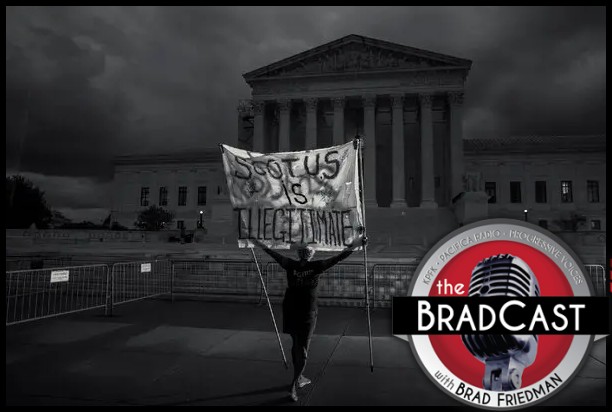
In Georgia, meanwhile, more counting of absentee and provisional ballots ordered by federal courts to be included in the tallies continued, as Republican Gubernatorial candidate and vote suppressor Brian Kemp called again for counting to end. He remains just 0.22% above the mark that would trigger a December runoff with Democratic nominee Stacey Abrams. Her campaign continues to decry Kemp’s horrific administration of the election while Secretary of State, and many outside the state — including Ohio’s Democratic U.S. Sen. Sherrod Brown — now see a Kemp victory, if it happens, as illegitimate. Brown went so far as to say: “If Stacey Abrams doesn’t win in Georgia, they stole it. I say that publicly, it’s clear.”
The maddening story of 92-year old African-American voter Christine Jordan’s fight to even cast a provisional ballot this year in Georgia (after voting in the same place for the last 50 years!), underscores that argument, as we discuss today.
Finally, Desi Doyen joins us for the latest Green News Report, with grim news on the rising death toll in California’s record wildfires, some accountability for a top EPA official who was arrested today, and new Democrats in the U.S. House are already moving for bold action on climate change…






















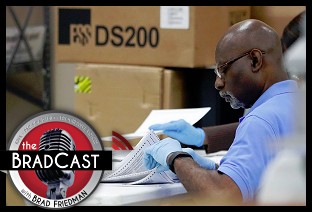
Fun little box in the background of the photo I’ve used on today’s logo, for those who might be interested in such things and/or might not have noticed…
Brad,
Thanks for the tip on the DS200 box.
I looked it up in Wikipedia and found problems listed from WAY BACK IN 2010 regarding those machines.
EXCERPT:
“Reported problems during the 2010 election
On April 14, 2010, the Cleveland Plain Dealer reported that “About 10 percent of Cuyahoga County’s voting machines “¦ [had] failed a pre-election test.”[33] After 20 months of investigating the DS200 Precinct Count Optical Scanner in the EAC-certified Unity 3.2.0.0 voting system, on December 22, 2011, the Election Assistance Commission recommended decertification of the ES&S voting machine if it cannot be fixed. From the findings:[34]
“The DS200 accepts a voted ballot but does not record the ballot on its internal counter. In addition the marks of the second ballot are not recorded.”
“When a 17″ ballot was inserted at an angle, the DS200 did not consistently count the mark properly. The mark registered either as a different selection than intended or did not register at all.”
The system randomly freezes and does not record the freeze in its log files. There are other events not logged, such as touch screen calibration.
In May 2013, however, the Election Assistance Commission certified the DS200 as part of ES&S’ EVS 5.0 election management system as meeting its 2005 Voluntary Voting Systems Guidelines (VVSG).”
from:
https://en.wikipedia.org/wiki/E...s_%26_Software
WTF????????????????????
Dear Brad, Am I allowed to take a picture of my completed ballot when I vote in person at my polling place in L.A., CA? Immediately before I handed my completed ballot to the poll worker, I asked if I could take a picture of my ballot. She said that I could not. Is she correct?
Brad,
Can you go into more detail behind your opinion of Rank Choice voting. It provides a useful wedge to break the lock the two main parties have on our democracy.
Stephanie (#3), the reason taking a photo of your ballot may be illegal in some states is to prevent you from “selling your vote” (and using the photo as proof to collect your payment).
Brad, I was very disappointed in your smearing of Ranked Choice Voting, especially your strawman argument against it. There is nothing inherently confusing or difficult about such voting. Your security concerns (spooky “algorythm”) are misplaced: there is nothing about RCV that requires machine count more than any other kind of voting. I urge folks to go to http://www.rcvmaine.com to educate themselves on this exciting voting option.
Election Integrity is very important, but it is not the ONLY thing in elections that needs fixing. In multicandidate races, voters ought to be able to express their actual preferences instead of being forced to engage in “strategic voting”. RCV achieves that. RCV also leads to less mudslinging, because candidates what to court the votes of (some of) their rivals.
In my opinion, RCV is far superior to “Jungle Primaries” or plurality “winners” or costly/low turn out run-offs between top two in plurality contests. There are no integrity concerns that are any different than any other form of voting.
I, too, would like to hear more on your objections to Ranked Choice or Instant Runoff Voting. It seems eminently sensible to me.
Stephanie @3:
Randal (@3) is correct about the general concerns about so-called “ballot selfies”, though, in truth, with more than 50% of the votes cast in California now being Vote-by-Mail, it’s somewhat disingenuous for those opposed to such photos to offer that argument, since that’s exactly what can easily be done with VBM.
(Not suggesting that’s the case with Randal. Don’t know his own position. But he correctly cited why some have concerns about it.)
That said, I don’t know that there is as statute on this one way or another in California. Under the previous SoS, Debra Bowen, she told me she had no prob with folks taking photos of their OWN voting processes, so long as it didn’t invade anyone else’s privacy in the polling place.
I believe it’s still perfectly legal in CA, but I don’t know if current SoS Padilla has his own policy/guidelines on it or not. And, of course, I’m neither an attorney nor an expert in CA Election Code, so please don’t take my thoughts here as any sort of legal advice.
Adam @4 and Randal @5 and David @6:
I’ve held (and publicly shared) this position on RCV/IRV for many years. In the very eary days, I was sympathetic of the general reasoning for RCV, so support it (or what we used to call Instant Runoff Voting or IRV). And I still support the general principals. But, having covered this beat for as many years as I have, I stand by my initial awakening/change of heart, that IRV/RCV is a terrible idea right now. If we have this much trouble overseeing the accurate addition of 1 + 1 + 1 in our elections, adding the complicated algebra of RCV to it (which requires computer tabulation, btw) is insane.
RCV elections cannot be hand counted (in anything other than a race that takes place at one precinct), and it’s virtually impossible for the public to oversee accurate results.
I have spoken to candidates and voters over the years who have been baffled by RCV elections, including candidates who have no idea why they lost an RCV election!
There is a reason why many jurisdictions have done away with it shortly after adopting it and trying to it out, only to have voters and candidates alike hate it.
I’ve held this position for years, and I would disagree with my characterization of it on yesterday’s show as “smearing” it, as Randal charged. I’m offering my insight and concerns about it, and certainly welcome the thoughts of folks who see things differently than I do.
I spoke about RCV in a bit more detail not long ago in this show over the summer.
ALL OF THAT SAID, I remain sympathetic to the reasons that many support RCV, and to that end, I’d be willing to compromise with Approval Voting, which accomplishes most of the same things that RCV does, but in a way that voters and candidates can more easily understand and that can be easily hand-counted at each precinct without requiring computers or centralized tallies.
Approval Voting (AV), essentially, allows you to vote Yes/No for every candidate in the race. It also does away with the so-called “spoiler” effect in the bargain, and allows voters to support third-party candidates, etc., in a way that can be understood and overseen by the public.
(It can also be tabulated, for what it’s worth, with all of our existing computer tabulation systems without needing to upgrade or reprogram, etc. Though that’s just an added reason why moving to AV is much easier — and safer — than RCV.)
Hope that helps to clarify my position!